How we grow fresh ideas…
Duemosegaard – a farm where ideas are grown
In between Farum and Birkerød, in the rolling countryside just north of Greater Copenhagen lies Duemosegaard (Dove Lake Farm) an old farmstead from 1895, home to Ross and Heather Jackson. Any comparison to a conventional farm stops there.
Ross has a background as an economist, philanthropist, author, and visionary environmental activist, Heather as an artist, former international designer and writer who runs the farm, exhibitions and events. Between them within the whitewashed walls of the house, in the compost heap and converted farm buildings the seeds of ideas are raised, nourished and brought to fruition.
Reign of “Terroir“
Agriculture occupies more than 60% of Denmark’s area, biodiversity is under threat and ressource consumption is among the highest in the world. Back in the 1970s just taking a drive through the blossoming Danish countryside in summer would leave the windscreen splatted by insects. Nowadays the glass is clean, all is sterile, the food chain is shattered by over farming and the over-liberal use of pesticides. Ross and Heather have, in the autumn of 2023 decided to convert their 19 hectares of organic fields into an experiment in skovlandbrug (no plough agriculture). The land will be left to recover for 5 years and a special mixture of 24 seeds has been sown, which will lead to deep-rooted fodder plants breaking up the compacted soil and adding life-giving nutrients and, well, flora. Trees and fruit bushes in 2.6 hectares of specially fenced in land will be planted in the late autumn.
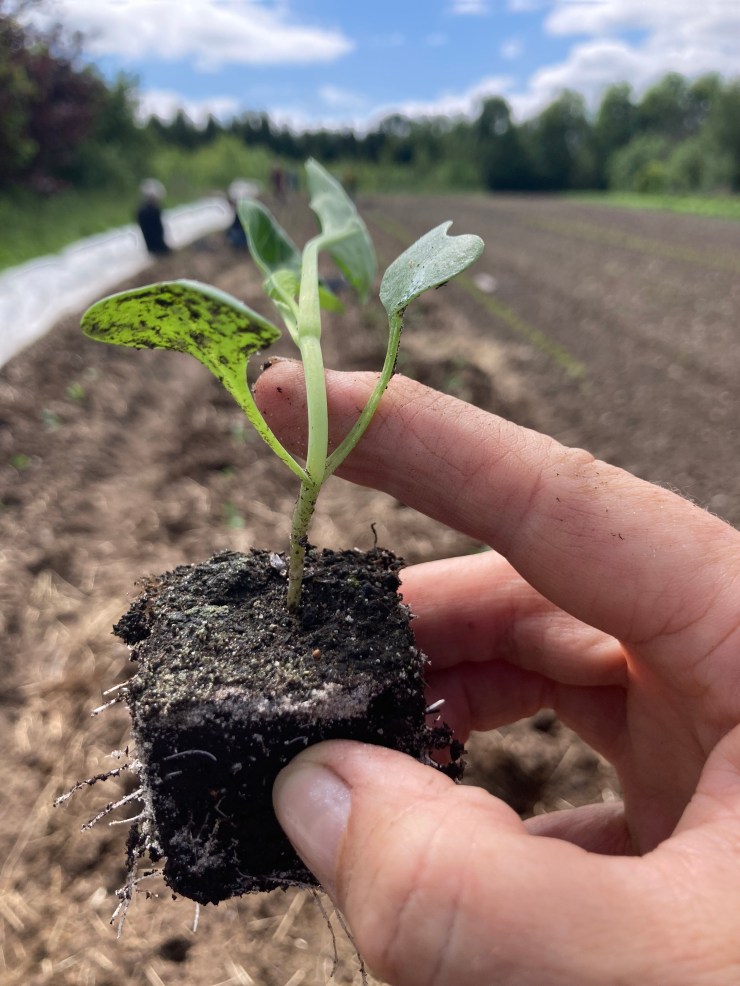
For twelve years 4000 m2 of the farmland at Duemosegaard has been dedicated to Fællesgrønt (communal gardens). Where 25 local families have been invited to participate in planning, enriching, planting, tending and the harvesting of ’biodynamic’ produce. Biodynamic farming follows the teachings of Rudolf Steiner and his organic theories on the wonders of manure, the moon, no pesticides and a dash of hocus pocus. Whichever fruits, vegetables and fellowship that are raised on the (now) terrific soil have flavours, textures and colours which are so intensely rich and different from conventionally farmed produce. The families who till the soil with Ross and Heather are an eclectic and hearty bunch who enjoy working alongside eachother and raising food in a regenerative way. At present there is space for four new members to the group, the only requirement is that twenty hours of work are made in the fields or barn across the year and a fee of 1800 kr is paid towards seed, equipment and plants.
Deep Roots
The roots of this eco-friendly place are firmly planted in the 1980s, and the establishment by Ross Jackson and his former wife, Hildur of the Global Ecovillage Network (GEN). Ross was before his time in recognising the fragile state of our denuded planet, and the need to tend to the earth itself instead of the headlong dash into a world poisoned by the toxic capitalist attitude of progress at all costs, especially regarding the natural world. GEN nowadays is an information exchange using educational programmes designed by Gaia Education, newsletters and knowledge disseminated amongst the thousands of projects across the world that are building and living in small intentional communities in harmony with nature.
Eco-nomics
An economist and successful businessman, physicist by training and Canadian by birth, Ross co-founded Simcorp, which is today a leading global financial software company and was the major shareholder in Urtekram, Scandinavia’s largest organic food wholesaler. From the 1980s onwards Ross dedicated a large amount of his time, colossal intellect and organisational skills towards putting structure into The Global Ecovillage Network and forming The Gaia Trust, a Danish-based charitable entity in 1987 to promote a more sustainable world. These days Ross is writing his seventh book, The Bad News and The Good News – Economics for a Regenerative society. This time on the future of the world economy and the need to urgently make amends for the failures of the industrial age on the our financial thinking versus climate change.
Out of the Box and into a War Zone
The Global Ecovillage Network truly came into it’s stride during the Russian invasion of Ukraine, when ecovillages across Europe rallied to assist displaced refugees fleeing from destruction. As conventional aid agencies waited at closed borders, the Ukrainian network of ecovillages rallied in conjunction with their European cousins and provided badly needed food, shelter and medical supplies within three days. Last year Duemosegaard Samtalerene (the Duemosegaard Conversations – a series of talks held at the farm by movers and shakers in sustainablity and enviromentalism) hosted a vivid presentation by some young Ukrainian volunteers who have been active in organising and distributing supplies and expertise to thrier wartorn homeland using the incledibly proactive networks and iniatives of ecovillagers in Ukraine and across Europe. The bottom line being that the free-thinkers who inhabit ecovillages have never lived in boxes, when disaster strikes it’s these kind of people who take the lead.
 Duemosegaard